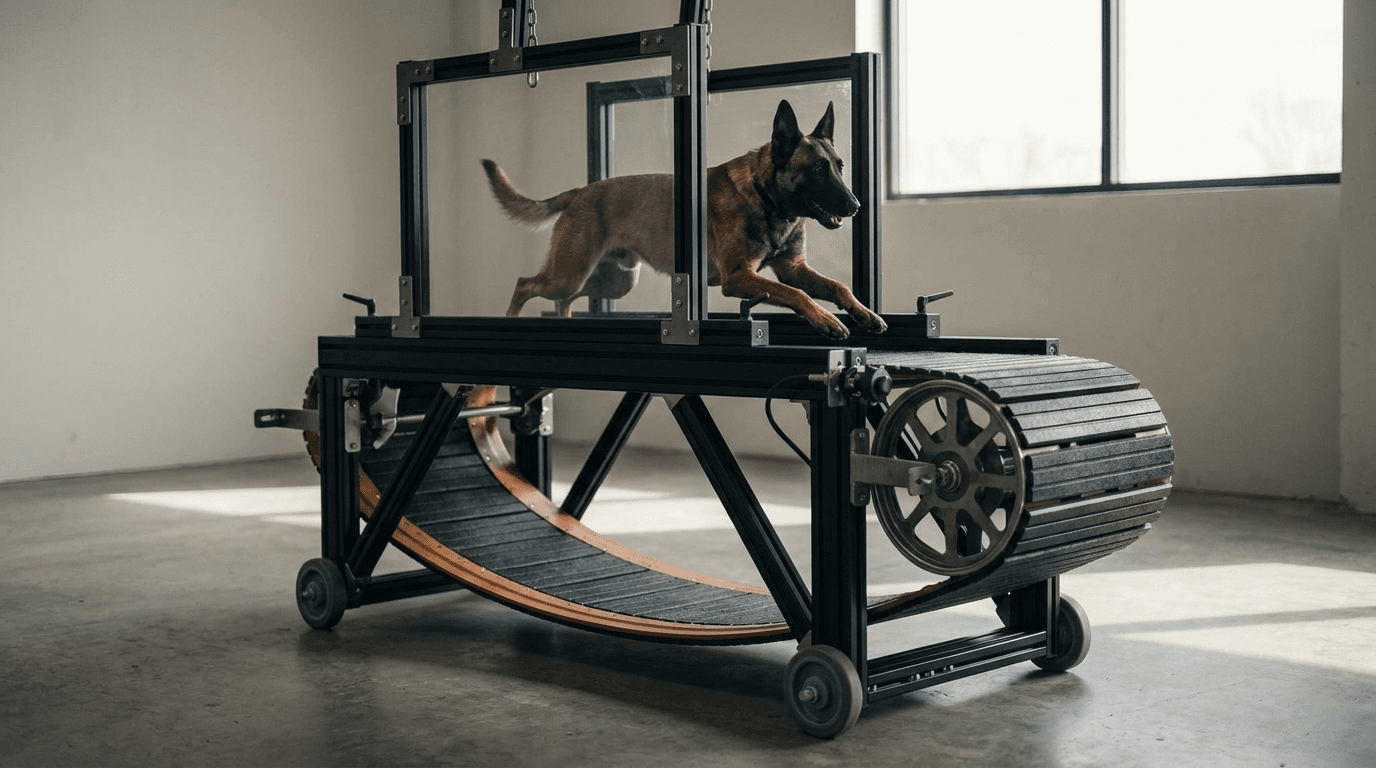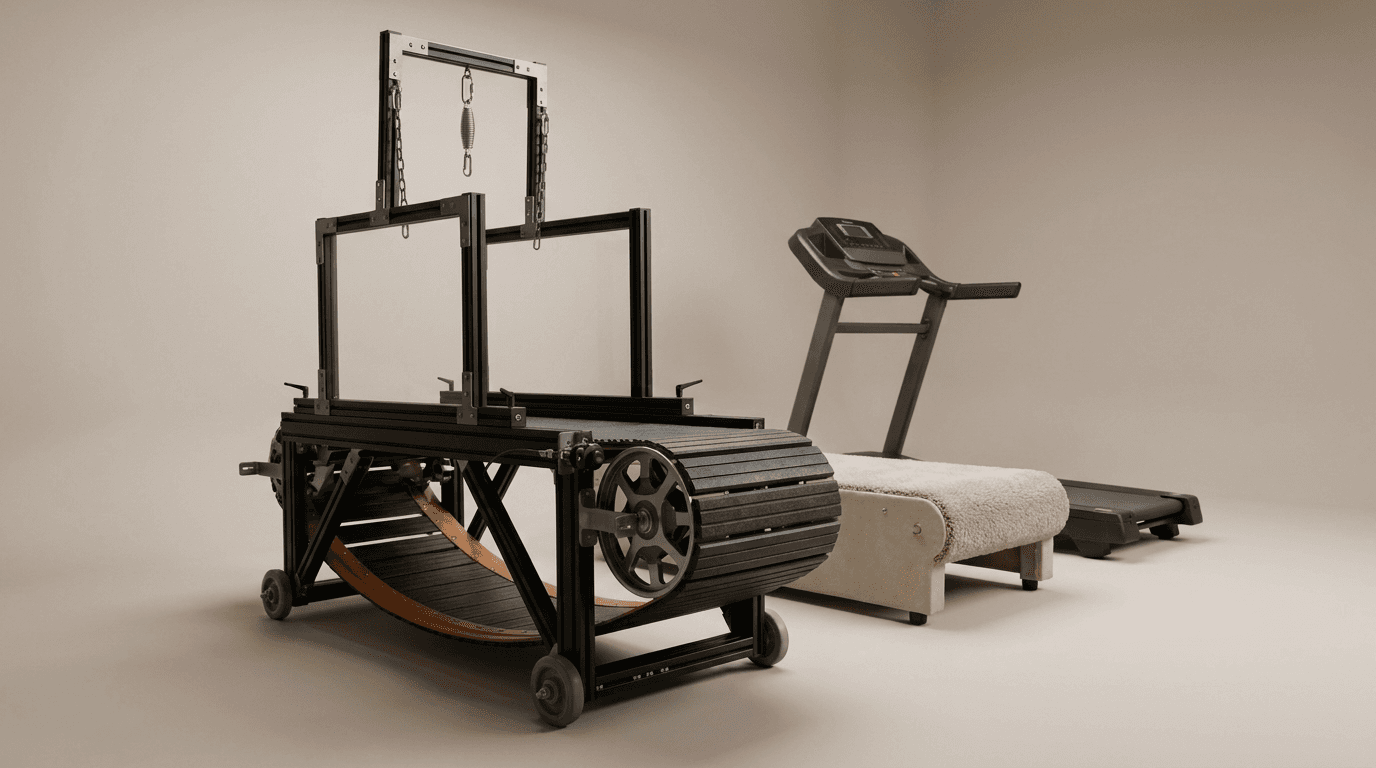
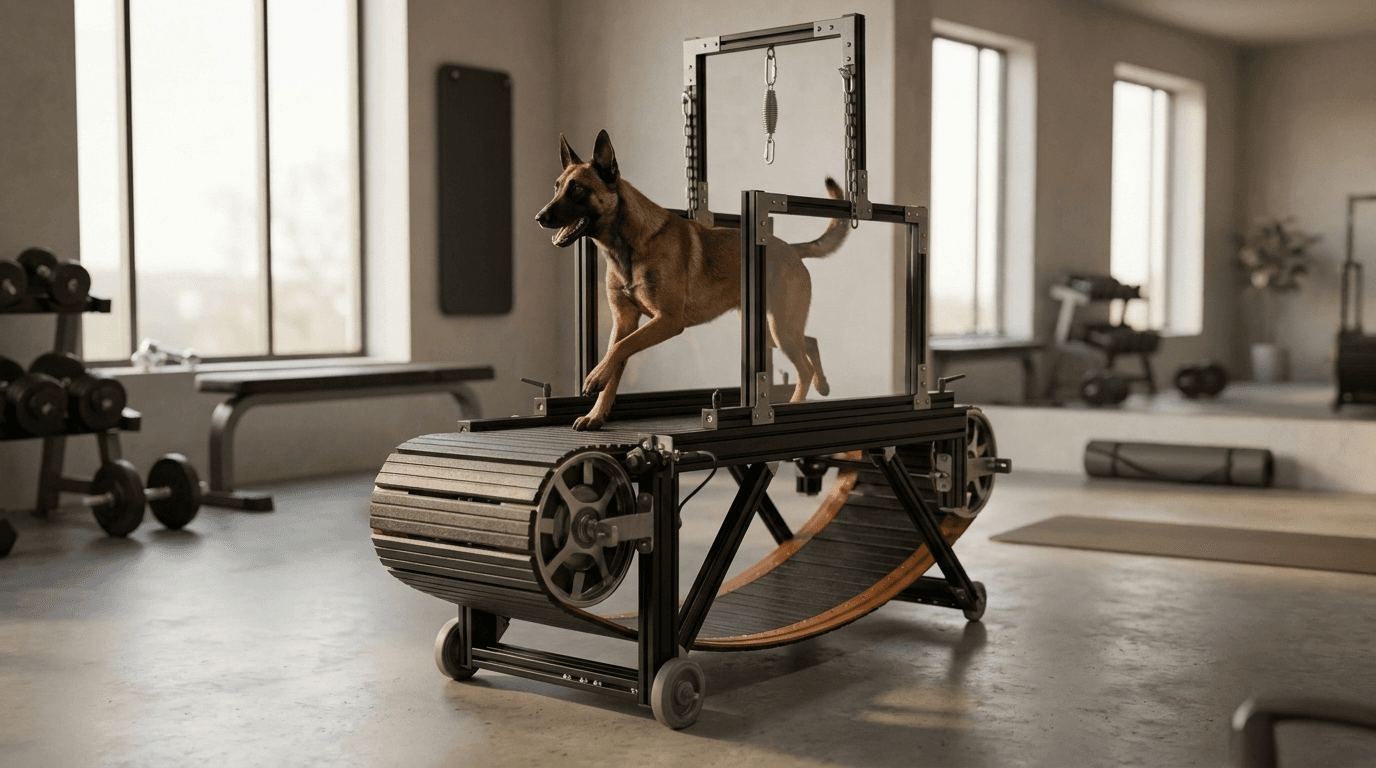
A slatmill is a non-motorized, dog-powered treadmill with a running surface made of interlocking slats — wood, composite, or aluminum — connected to a belt that wraps around rollers. The dog's stride turns the belt. No electricity, no motor. If the dog stops, the belt stops.
That last part is what makes it fundamentally different from a motorized treadmill, and fundamentally safer.
How a Slatmill Works
The mechanics are simple. Individual slats are mounted between two large rollers with sealed bearings. When your dog pushes forward, the slats rotate around the rollers in a continuous loop. The slats form a solid, flat surface when horizontal but flex around the rollers at each end.
Resistance comes from the weight of the slats, bearing friction, and belt tension. This natural drag means every session is combined cardio and strength work — your dog is essentially running slightly uphill at all times.
Many models include a manual ratchet-style incline to increase intensity further.
A Brief History
Dog-powered treadmills actually predate human treadmills. In the 1700s-1800s, dogs ran on treadmills to power domestic chores — churning butter, grinding grain, running cream separators.
Nicholas Potter of Troy, Pennsylvania patented the first commercial dog treadmill in 1871 — the "Enterprise Dog Power." The first dog treadmill marketed specifically for exercise was patented by John R. Richards of Oak Park, Illinois in 1939.
The modern slatmill evolved from these working-dog machines into purpose-built fitness equipment used by sport dog handlers, K9 units, and now everyday pet owners.
Who Uses Slatmills?
Slatmill vs. Motorized Treadmill
The key difference: on a slatmill, your dog controls the pace. On a motorized treadmill, you do.
A slatmill is safer because the dog can stop any time simply by stopping. On a motorized treadmill, if the dog slows down or stumbles, the motor keeps running — which is how injuries happen.
Slatmills also burn more calories per session because the dog is actively driving the belt, not passively keeping up with it.
Slatmill vs. Carpet Mill
A carpet mill is also dog-powered, but uses a carpet surface instead of slats. The carpet creates 4-5x more resistance than a slatmill, making it better for building raw strength and muscle power.
Slatmill = endurance and cardio. Carpet mill = strength and power. Many serious trainers use both.Benefits of Slatmill Training
Physical: Cardiovascular health, even muscle engagement (quads, hamstrings, core), weight management, fewer repetitive-strain injuries compared to running on concrete. Mental: The dog makes decisions about pace, which engages their brain. The repetitive, self-controlled motion releases endorphins and helps dogs self-regulate emotions. Behavioral: Destructive chewing, barking, digging, and reactivity all decrease with consistent slatmill use. A tired dog is a well-behaved dog. Practical: Weather-independent, schedule-independent exercise. Rain, snow, or extreme heat — your dog still gets a real workout.Common Misconceptions
"Slatmills are cruel." The dog controls the pace entirely. They can stop anytime. The cruelty association comes from a historical link to dog fighting, which has unfairly tainted the equipment itself. "It replaces walks." No. A slatmill supplements outdoor time — dogs still need fresh air, socialization, and varied terrain. It's a conditioning tool, not a lifestyle replacement. "Any dog will just hop on and run." Most dogs need a gradual introduction with positive reinforcement. Rushing this step is the #1 beginner mistake.What to Look for When Buying
Ready to Get Started?
The HoundPower Pro Slatmill is built with upgraded suspension, precision braking, and a built-in speedometer — everything your dog needs for safe, effective conditioning.
Shop HoundPower Slatmills →